Case StudyRestaurantOS - A Comprehensive Restaurant Management Platform
In the competitive hospitality industry, modern restaurants require a centralized, efficient system to manage their daily operations, understand their customers, and make data-driven decisions. Our client, a technology innovator in the food service sector, needed a powerful and intuitive platform to bring all critical restaurant functions into a single, streamlined dashboard. The goal was to create RestaurantOS, a comprehensive Software-as-a-Service (SaaS) solution that empowers restaurant owners and managers to take full control of their business.

About
RestaurantOS is a comprehensive restaurant management platform designed to centralize and streamline all aspects of restaurant operations. Built with a modern stack including React.js, Nest.js, and MySQL, the platform provides restaurant managers with a unified solution for handling bookings, menus, customer reviews, promotions, and customer data. By integrating these key functions, RestaurantOS helps improve operational efficiency, enhance the customer experience, and provide data-driven insights to boost profitability.
Features
Centralized Dashboard
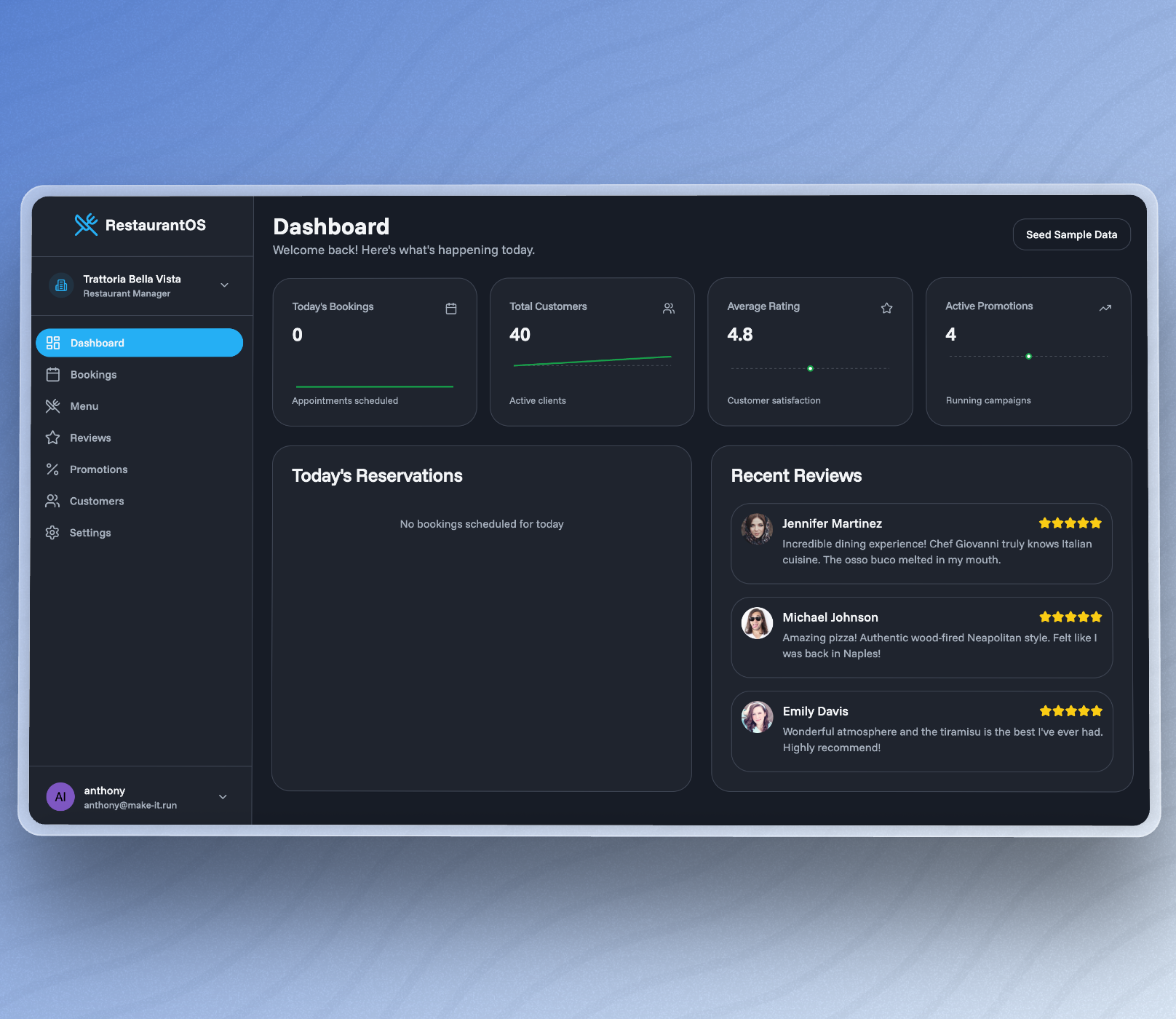
Provides a real-time overview of the restaurant’s performance at a glance. The dashboard displays key metrics such as Today’s Bookings, Total Customers, Average Rating, and Active Promotions. It also features a feed of today’s reservations and recent reviews, allowing managers to stay on top of daily operations and customer feedback from a single screen.
Bookings & Reservation Management
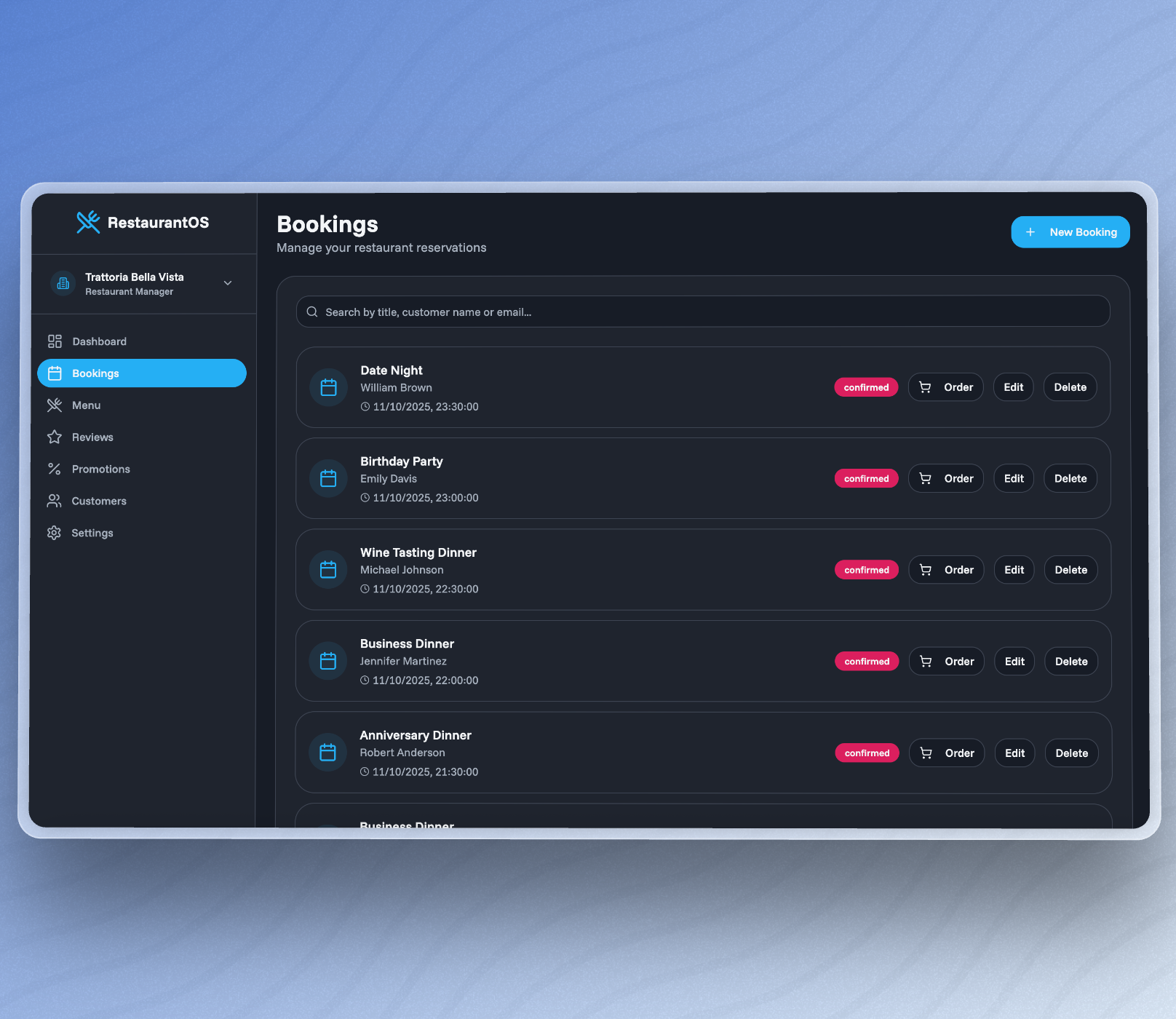
A complete system for managing all restaurant reservations. Managers can create new bookings, view a list of all upcoming reservations with their status (confirmed, pending, etc.), and manage details for each booking, such as the customer’s name and the event type (e.g., Date Night, Birthday Party). The system helps prevent overbooking and ensures a smooth seating process.
Dynamic Menu Management
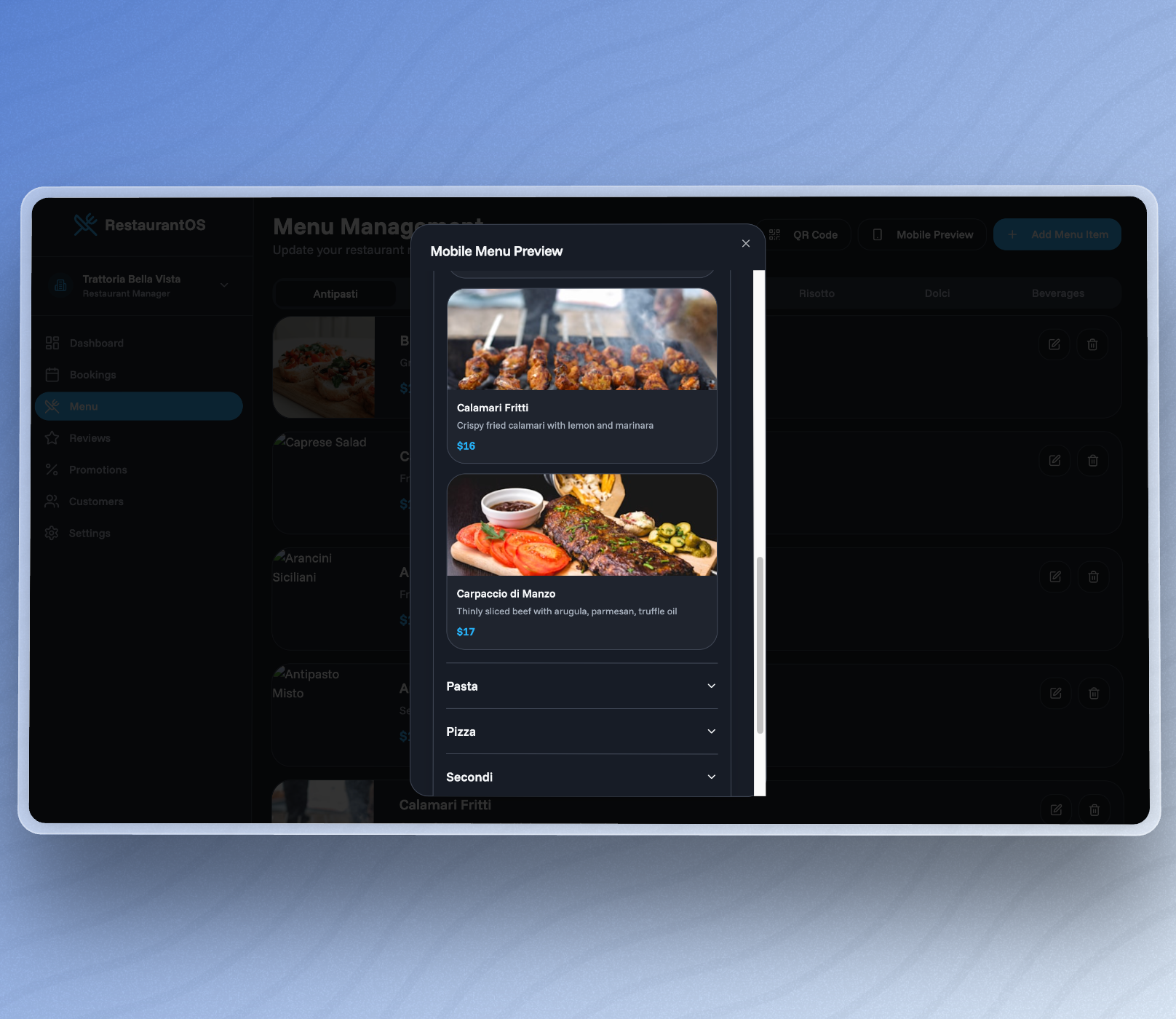
Allows for easy creation and management of the restaurant’s menu. Managers can add new menu items, set prices, write descriptions, and upload photos for each dish. The platform supports multiple categories like Antipasti, Pasta, Pizza, and Secondi. It also includes a Mobile Menu Preview feature, allowing managers to see how the menu will appear to customers on their mobile devices.
Integrated Order Management & POS
Streamlines the ordering and payment process directly from the booking system. For any given reservation, managers can add items to a customer’s order, calculate the total, and process payments. This feature integrates point-of-sale functionality directly into the management platform, simplifying the workflow for staff.
Review & Reputation Management
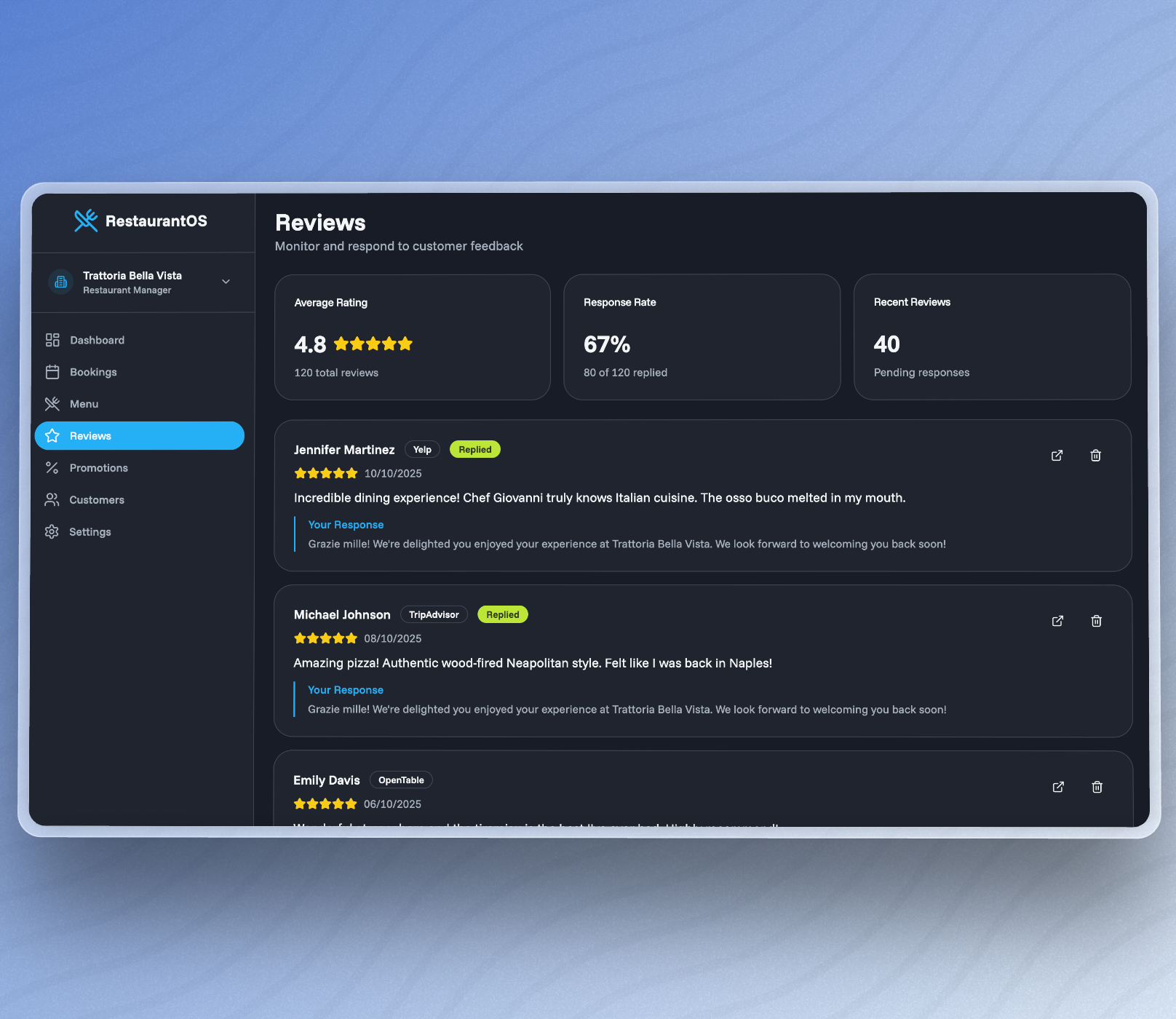
Aggregates customer reviews from multiple platforms like Yelp, TripAdvisor, and OpenTable into a single feed. The system displays the average rating, total reviews, and response rate. Managers can read all reviews and post public replies directly from the dashboard, helping to maintain a positive online reputation.
Promotions & Campaign Management
Enables the creation and management of promotional offers to attract customers. Managers can set up various promotions, such as percentage-based discounts (e.g., 20% off lunch), define the active dates for the campaign, and monitor all active promotions. This feature helps drive traffic during off-peak hours and for special events.
Customer Relationship Management (CRM)
A built-in CRM system to manage the restaurant’s customer base. The platform maintains a list of all customers, including their contact information and last visit date. This allows the restaurant to build a customer database for marketing and personalized service, fostering customer loyalty.
Technical Development
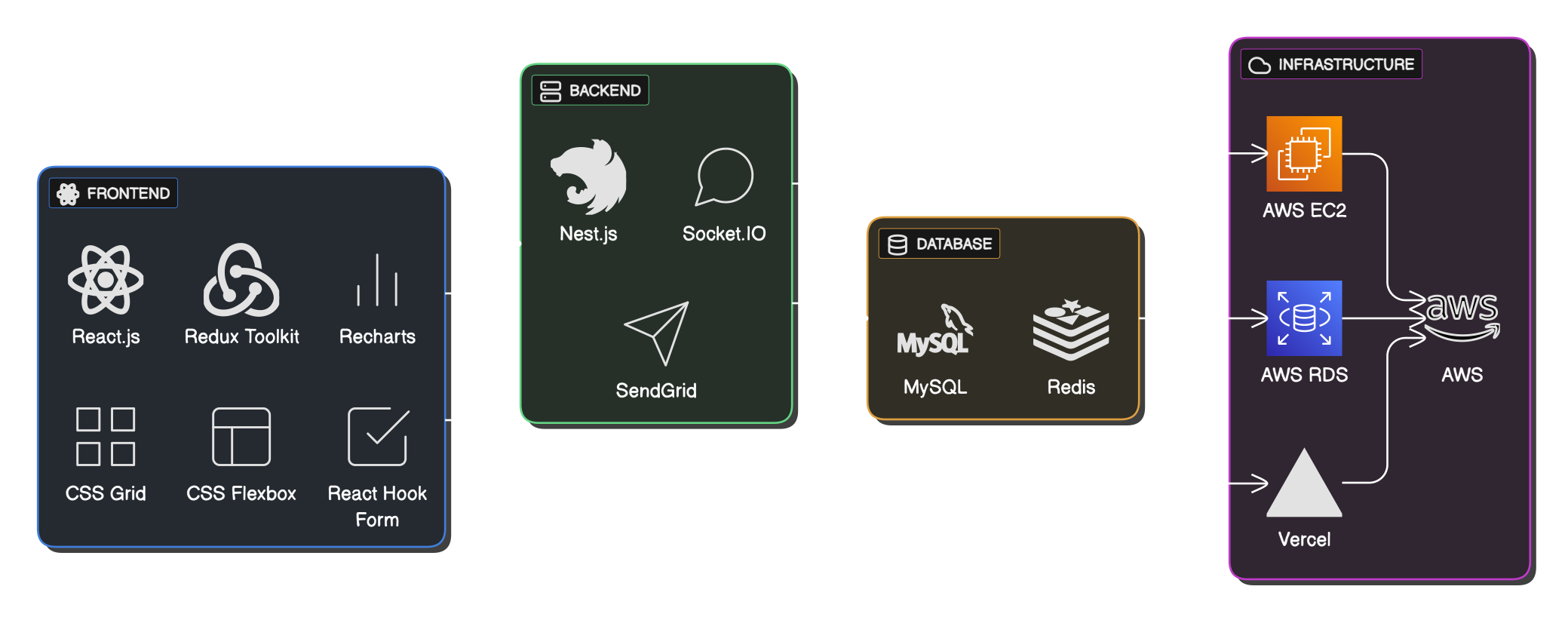
Stack
- React.js (Frontend)
- Nest.js (Backend Framework)
- MySQL (Database)
- Redis (Caching & Real-time Features)
- Socket.io (Real-time Communication)
- AWS (Cloud Infrastructure)
- Vercel (Frontend Deployment)
Dashboard & Analytics
Frontend Implementation: The dashboard is built with React.js and uses Recharts to render the simple, clean graphs for key metrics. The layout is constructed with CSS Grid and Flexbox for a responsive design that works on both desktop and tablet screens. State is managed with Redux Toolkit to handle the flow of data from the API to the various dashboard components.
Backend Implementation: The Nest.js backend creates a REST API that serves the aggregated data for the dashboard. An endpoint aggregates data from the bookings, customers, and reviews tables to provide the metrics in a single, efficient call. The data is cached using Redis for 1 minute to reduce database load.
Database Design: The MySQL database has tables for bookings, customers, reviews, and promotions. The dashboard queries are optimized using indexes on date columns and foreign keys to ensure fast data retrieval.
Booking & Reservation System
Frontend Implementation: The bookings page is a React.js component that fetches and displays a list of reservations. A search bar allows for real-time filtering of bookings by customer name or email. New bookings are created via a modal form that uses React Hook Form for validation and state management.
Backend Implementation: The Nest.js backend API provides CRUD endpoints for bookings. When a new booking is created, the system checks for table availability to prevent double bookings. The backend sends automated confirmation emails to customers upon booking using a service like SendGrid.
Database Design: The bookings table has columns for customer_id, booking_time, party_size, and status. A foreign key links to the customers table. An index on booking_time ensures efficient querying for upcoming reservations.
Menu & Order Management
Frontend Implementation: The menu management interface is built with React.js and allows for drag-and-drop reordering of menu items. The Mobile Menu Preview is an iframe that displays a separate, simplified React.js component to mimic the customer-facing view. The order management modal allows staff to add items to a customer’s bill and process payments.
Backend Implementation: The Nest.js backend provides API endpoints for managing menu items. The order processing endpoint integrates with payment processing systems to handle credit card payments securely. The backend calculates the total for the order, including taxes, and processes the payment.
Database Design: A menu_items table in MySQL stores all dishes with columns for name, description, price, and category. The orders and order_items tables manage customer orders, with foreign keys linking to the customers and menu_items tables.
Review & Reputation Management
Frontend Implementation: The reviews page fetches reviews from the backend and displays them in a list. A React.js component allows managers to write and submit a response for each review. The response is then displayed nested under the original review.
Backend Implementation: The Nest.js backend has a service that periodically fetches reviews from third-party APIs like Yelp and TripAdvisor. The reviews are stored in the MySQL database. When a manager submits a response, the backend sends it to the respective platform’s API.
Database Design: The reviews table in MySQL stores the review content, rating, source (e.g., Yelp), and the manager’s response. This allows for historical tracking of all customer feedback.
Deployment
The RestaurantOS platform is deployed using a modern, cloud-native architecture. The React.js frontend is deployed on Vercel with automatic builds from Git and edge caching on 100+ global locations. The Nest.js backend is deployed on AWS using EC2 instances with auto-scaling based on traffic. Socket.io enables real-time bidirectional communication between clients and the server for live updates on bookings and orders. Redis is used for session management, caching, and real-time data synchronization. The MySQL database is hosted on AWS RDS with automated daily backups, Multi-AZ deployment for 99.9% availability, and read replicas for query load distribution.
Project Details
- Client
- RestaurantOS
- Date
- October 2025
Industries
Application Types
 React.js
 Nest.js
 MySQL
MySQL Redis
Redis Socket.io
 AWS
AWS Vercel


